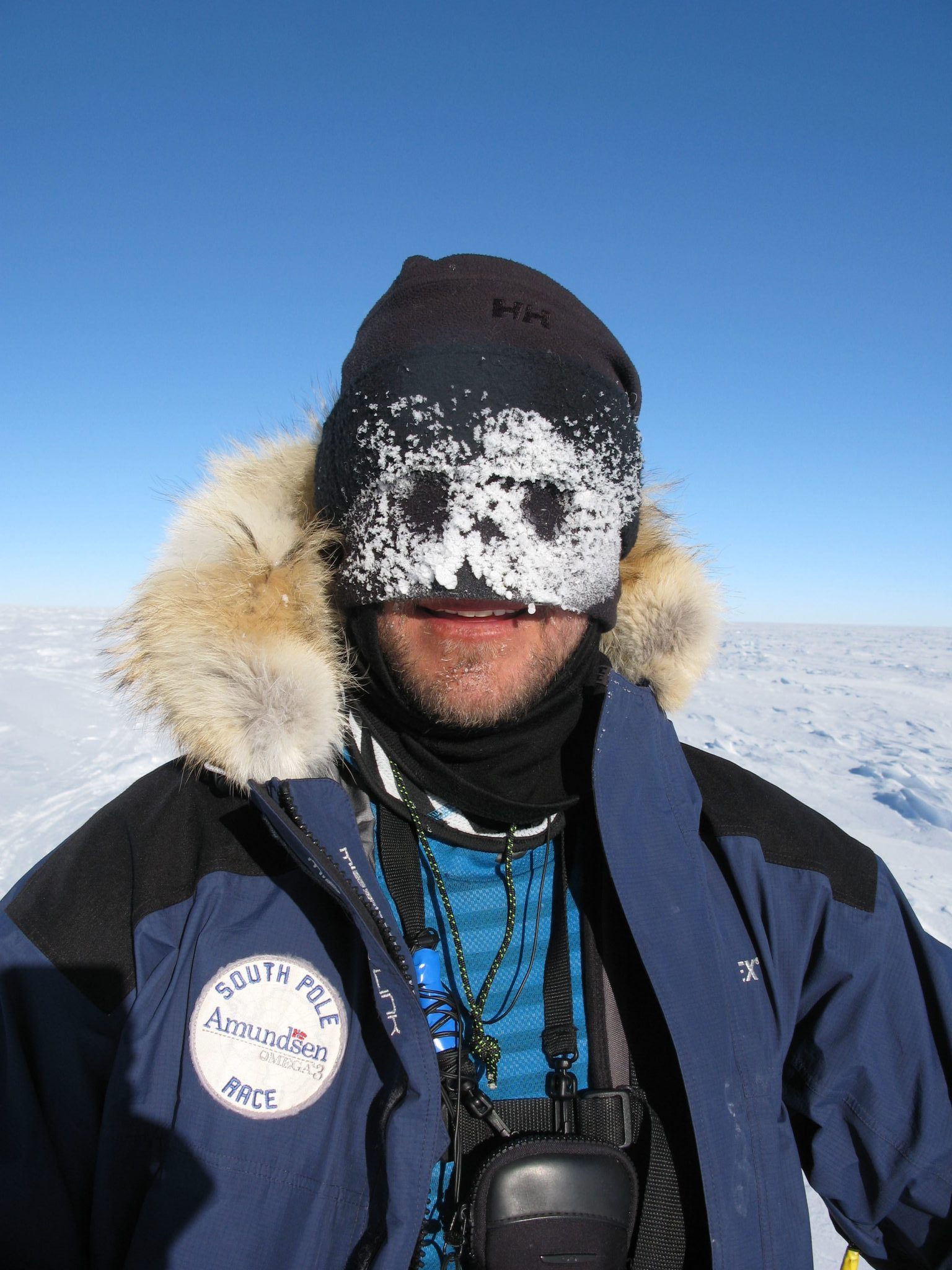
In December 2008 international teams will race over 1000 kilometers to the Geographic South Pole.
The Reason
Imagine you are dragging a sledge of provisions that you need to survive. Imagine you are walking in temperatures as low as - 50°C. Any parts of your body which become exposed will be lost to frost bite. You have been dropped at the bottom of the earth and you are in a race to the South Pole. Now, imagine you are doing this, but you are blind…
32-year-old adventurer Mark Pollock hopes to become the first blind person to trek the 1,000 kilometers across Antarctica to the South Pole. Mark’s two teammates, Simon O’Donnell and Inge Solheim, will guide him through the blinding whiteness for 40 days, all three pushing themselves mentally and physically to the edge. Doing this in their own good time was not enough of a challenge and the men are racing against 5 other teams including TV presenter Ben Fogle and double Olympic gold medallist James Cracknell.
The event is the first international race to the South Pole since the legendary race between Captain Scott and Norwegian explorer Roald Amundsen nearly 100 years ago and it begins mid December 2008 and finishes over 45 days later in early February 2009.
Mark wasn’t always blind. When Mark could see he had a very strong sense of who he was. His identity was mapped out and pinned down by traits - a born athlete, happiest in a team, whether it was the rowing team or his friends - all together, all aiming for some common purpose.
This carried Mark through to University in Trinity College Dublin where in 1998 he was graduating from his business degree, captain of the rowing club, had a selection to row for his country at the World Championships under his belt and a job in London to graduate to.
Then suddenly, Mark couldn't see. At 22 years of age, a detached retina left him completely blind. Mark lost his sight and with it, his independence and his identity. Says Mark: “The shock of going blind was so great that i denied it was real. I truly expected every morning to wake up and for it all to have been some sort of horrible mistake. One moment, I was living a dream - student, athlete, great social life, girlfriend. The next moment - lying in bed, listening to too much talk radio and praying for the impossible. I didn’t know how to be; I didn’t know who I was, I had no identity other than: ‘Mark - can’t tell what clothes I’m wearing, can’t get a job, can't have a relationship, can’t row’…
Then a number of life lines were dropped in. A few months after going blind a computer which talks to him gave him the ability to, not only work, but to be independent, to have purpose and challenge. Soon after, Mark got Larry, his guide dog. For the last ten years Larry has been his city centre transport system, his friend and part of his identity. Mark explains that with a white stick, or a ‘symbol cane’, he was saying - help me, I’m blind. With a guide dog he was independent, going somewhere.
Having regained his life – his ability to work and compete in sport, Mark got back in the rowing boat and won a silver and bronze in the Commonwealth Regatta. He has competed in the Gobi March (six marathons in six days), competed against Sir Ranulph Fiennes and Sean Birch in the extreme marathon at the North Pole, kayaked across the Irish Sea, raced an IronMan Triathlon, and most recently completed The Dead Sea Ultra Marathon (the world’s lowest marathon) and the Everest Marathon (the world’s highest marathon).
Ten years on, in 2008, Mark knew he had to mark the 10th anniversary of his going blind. Anniversaries like that can mark you if you don't get in there first. Ten years after losing his sight, the South Pole Race is the first event in a long time that he has been scared of. Afraid he won’t finish, afraid he will lose one of his vital remaining 4 senses to frostbite, afraid he will slow the team down. Because it is going to be outside his comfort zone, because he has to compete with himself, but is back in a team, Mark feels he is finally arriving where he left off before going blind. He is in the race. As he says himself: “For the first time in a long time, I don’t have to run away from my own story - it fits, it feels right...”
Learning To Ski
On Saturday the 26th of January 2008 I had done my first training session of the year. Six weeks later, I had completed nearly sixty training sessions. Three weeks later, on my birthday, the 29th of February 2008 I officially entered the South Pole Race. Excited, now committed and completely deluded as to how much would go into something this big, things were on the up!
Once I had committed to the race I had to find out if I could ski. As luck would have it, I was booked on the 27th of February to deliver one of my talks to a company in Chamonix, France. Coincidentally, my friend Nick Wolfe and Gobi race partner was in Switzerland learning how to be a horologist (watchmaker) and he met up with me in Chamonix for a couple of days skiing.
I flew into Geneva on Friday the 22nd of February and Nick picked me up in a camper van, which was to be our home for three nights. I had never stayed in a camper van but it was brilliant – complete independence. We headed up to Chamonix, hired the skis and boots and got started. I had skied once before, on a school trip when I was fifteen. Back then, I could still see. There is a cross country course in Chamonix and we spent a few hours on the Saturday teaching ourselves - it was really enjoyable. In fact, I couldn’t believe I hadn’t tried it sooner. In contrast to an afternoon kicking rocks up the side of a mountain or in a desert, strangely enough skiing is relatively blind-friendly.
This would probably seem like a strange comparison and it is difficult for me to clarify. I am now, I suppose, so used to being blind that I sometimes forget about it completely. The brain is an amazing thing. I know this is hard for people to understand, but I have put a lot of effort into making the disability, at worst, an inconvenience, at least on a day to day basis. It does sometimes hit me, but when I am on my own, moving around my house, or even when travelling abroad, I rarely specifically think about the blindness.
For the South Pole Race I knew at the outset that the guiding system would be different from any other race I had done before. For a start, the teams are of three people, which would allow for different options of guiding. Another difference was that we would be pulling sledges. For the first time I would be prevented from being close enough to whoever was guiding me to hear them. Plus we were going to be on skis, which require a greater distance between me and whoever is guiding. I knew that a final consideration - which was a factor when i ran a marathon at the North Pole – would be that due to temperatures of -50 C, we would struggle to hear each other through the thermal head gear, hats and hoods.
I knew we would have to come up with something that worked and get it right before we left. You cannot play at adventuring at the South Pole, especially not with the added blindness factors. But in Chamonix I was just happy that I could slide one foot in front of the other, gliding free across the smooth, grooves carved into the snow. I didn't have to hold Nick's elbow, and it was sunny enough that we didn’t need hats; he could guide me with his voice.
The possibilities seemed endless and the detail of sledges and hoods and the rest could be worked out at some stage. For now, that sensible voice was drowned out in my head by the joy of sitting in the camper van with Nicko de Wolfe (his new Swiss name), his new guitar and him singing his first song he had learned on it - true to Nick's cheesy form it was David Brent's "Free Lovin' on The Free Love Highway" - through a mouthful of pesto pasta. This was what adventure racing was all about.
Cranking Up Training
Around mid-April my friend Ross and I were having a chat over coffee. I was complaining about my practical difficulties getting to training and the loneliness and motivational issues of then doing it alone. Ross instantly thought of his mate Simon O’Donnell. Simon is a professional strength and conditioning coach, working with rugby clubs, in particular Clontarf Rugby Club in Dublin, a well-known club for feeding players into the Leinster and Irish teams. Ross said, “He’s a good guy and he might be keen on getting the experience by training you.”
And so he was. By June I was training hard. Simon put together a training programme specific to the event for me and, most importantly, he volunteered to train every day with me, for free. Coming from a background in competitive team sports, in recent years he had been exploring new ways of getting wet, tired and muddy. In 2003, he had done a three year course in Outdoor Adventure Management during which he took part in a number of expeditions around Ireland, Corsica and the Indian Himalaya. Being a part of the informal team preparing for the South Pole Race was just what he was looking for.
By June we were meeting either at his rugby club or in the city centre and using the gym and latterly the climbing wall in Trinity. We would also meet at Island Bridge at my old rowing club and pick up our car tires and do 6 hour tire pulls around Memorial Park. This was a place I used to cycle to, when I could see, for those early morning training sessions. Training with Simon was reminding me of why, in part, I loved it so much. After an hour on the water, I would cycle back to my house, to College or to work having stolen the morning from everyone else in the city still cuddled up in their scratchers. Any rower will tell you that getting onto that still misty water with only the ducks as company is worth the every torturous minute when the alarm rings.
Simon and I did circuits - pulling punch bags for a minute at maximum speed, then carrying dumbbells with straight arms as far as possible in 30 seconds, followed by a run around the perimeter of two rugby pitches. Those early sessions were all about legs screaming with pain carrying me into a whole hell of a world of pain. In May I had thanked Simon for a particularly vigorous session by finishing the last run on the circuit retching … (I always think if you get to the retching stage then it is well worth being fully sick).
When Simon sent me my seven month training programme I couldn’t wait to start. For the first time since finishing rowing, this was a programme I could actually follow. Being physically fit enough for the South Pole Race was looking possible. The search for simplicity can be very complicated. While there wasn’t any Rocky style wood chopping in my training schedule, there was tire pulling (to mimic the weight of the pulk), there were chin ups, which I did on a bar across the open hatch of the attic in my house, the ever-present running up steps and so on. No heart rate monitors, just maximum effort.
Without Simon training with me I could not have even done the sessions, as I could not see where I am going. Coming from a team sport background, I also simply do not train to this level by myself and I need training partners to work with and race against. You cannot develop a competitive edge on a treadmill and this is the really healthy part of training with other people. I knew now, that as well as the practical consideration where the race demanded you race in teams of three, competition, pride and maybe a little bit of ego helps to push me on, as it pushes all athletes on.
Suddenly the race launch was a symbolic date. It was being hosted by the race organisers in London and we were due to travel on the morning of the launch, the 10th of July 2008. The press would be there; James Cracknell and Ben Fogel’s part in the race would guarantee that. It was my job to ensure that we got as much coverage as possible in the hope that some of the sponsors I had been promised ought to be banging down my door would catch the story and hand us the fabled case of cash.
After the official press launch of the race, I was interviewed live by BBC News. The interviewer asked me a question that didn’t really have an answer for: “What on earth possesses you?” A reasonable question and one which many people had asked me over the years since I’d been involved in sport. Why get up in the early mornings and go rowing? Why ascend to Everest base camp at 5,500 metres with your heart thumping and head pounding and then race a marathon? And now they were asking me - why enter a race to the South Pole?
My answer at the BBC was about extending my world. It was about stretching my boundaries. Going beyond the safety of my house, to a job, to study and now ten years on, wondering if my world can be extended to the South Pole. On reflection however, the day of the BBC interview and official press launch of the race offered an example of what this is really all about. Why these adventures matter to me so much.
We were to be at the official race press launch in the Ice Bar in London’s Piccadilly at 10:30 am. I was set to fly with my girlfriend Simone from Dublin Airport the night before. However, as I came out of a late Orbis board meeting and turned on my phone, Simone had left a message for me to say that Dublin Airport was closed due to a broken radar. No flights were landing or taking off.
This was a disaster as I felt, in the interests of the overall project, that it was really important to be at the launch to represent our team. With time and options running out we had to move fast. Simone was already in the airport. I was in the city centre and we had no way of getting to London. Or perhaps more accurately, we could not fly that night and couldn’t be guaranteed to fly out the following day either.
By the time I heard the bad news on my voicemail, investigations were already well under way: alternative airports to leave from – Cork, Shannon, Belfast; Simone was negotiating with the ground staff in Dublin Airport to get us priority on the red-eye the next morning; and a friend in London was investigating train and bus options from the ferry port in Holyhead. Just as I found out we had missed the last ferry, we got confirmation that we had a 6:00am flight the next day ready to book out of Belfast and so the race to get to the London and the press launch was on…
I arrived at the airport at 11:00 pm and we boarded a bus to Belfast. The journey should have been 2 hours only and as the second hour passed I dropped off to sleep for a few minutes. I woke with a jolt and feeling a little strange I checked my watch. We were 1 hour late and as I tried to work out what was happening, Simone said, “We are stuck outside the gates of a closed bus park. The road is too narrow to turn around and get back on the motorway. I didn’t want to wake you – there is no point in both of us sitting here fuming.”
And so we waited. And waited. Another hour and spirits were starting to slide. An exhausted Simone asked me if I would never speak to her again if we didn’t make the Belfast flight, but the Dublin flight the next morning, which we had jettisoned, took off on time! I reassured her that we had at least tried – how could we do anymore.
Eventually a security guard appeared and opened the gate and Johnny P, my wonderful Dad who thought nothing of being woken in the middle of the night and Larry, my retired guide dog, took us off again to Belfast International Airport for a 5:00 am check-in.
We arrived sleepless in Piccadilly at 10:00 am. With hindsight, it seemed somewhat appropriate to have overcome a little hardship by the combined labours of both our formal and informal team on the day the race was launched.
The Ice Bar is kept at minus 5 degrees Celsius and the walls and pillars are made from ice. Even the glasses we drank from were made of ice. We were slipped into ponchos with fur hoods and entered the bar which was filled with photographers. We sat with the other competitors at one end of the room while Simone mingled with the photographers and journalists. It was all very strange and exciting – I could hear the cameras clicking and I presume the flashes were going off all over the place.
We emerged from the icy chamber to be greeted by Simon and Ross who had just arrived. They had missed the photos inside but there was a lot more to come. Within seconds, Ross was filming and Simon had passed out our team kit. As we pulled on our kit and the journalists and photographers buzzed around, everyone got to work. I suddenly realised that without instructions, without job descriptions, our little team knew what to do and got to it.
While I was doing interviews, the rest of the team were talking to journalists and photographers and as a result, our story was picked up by BBC News 24 and the Daily Telegraph and Telegraph TV! Everything came together because enough of us pushed enough of the right buttons – which ones worked to produce a cracking launch I’m still not sure.
Things slowly came to an end as the press left to whatever else they were due to cover that day and as it all calmed down we went for our first team lunch. I loved it. The others were talking about the day and what they had learned, who they had spoken to and planning for the next few months. They also talked about their lives, what they were up to, jobs and change, writing and creative endeavours, all in an atmosphere of understanding.
It was this I realised - the common purpose. This is the reason for the adventure. The team and the bonds that develop between them is the answer to that question: “What on earth possesses you?” This is what inspires adventurers to take on the challenge - belonging to something bigger than you, belonging to something cohesive and purposeful.
The Antarctic would offer the wildest extremes of personal challenge, yet I knew then it was the common purpose that was bringing me there.
I woke to shouts of, “Let’s go, let’s go, lets go!” We were out of our sleeping bags within seconds. It was 6:30 am and we were standing on a glacier, hearts racing, in nothing but our boxer shorts…
“Come on, don’t just stand there – get on with it!” another barked instruction from Gary. “It’s about aggression … non-emotional! … get in there.”
We ran over the ice and slowed at the edge of the glacial waters. Gary was still shouting at us. Our run had slowed to a walk and we began to sink into the icy pool cut in the glacier’s surface. Two and three steps and the water was rising. I was holding onto Simon and Noel for direction and one of them slipped as the icy layers broke below him. I don’t know which one fell first, as I was being something less than aggressive and non-emotional!
Another shout rained in. “Non-emotional!!” It was starting to make sense; we just had to go in. It was going to be cold, but we had committed to doing it so there wasn’t any point putting a pained expression on - just get on with it.
Moving at speed now, we entered the pool up to our chests in freezing ice filled water and dived, or perhaps more accurately belly flopped, in. I have very little memory of the next few moments but after going under the ice I know we had broken our hold on each other. As I resurfaced, I was up and running. I could hear Gary shouting at us and I headed straight for his voice. In fact, I was told afterwards that I exited the water and left the guys behind so quickly that people were wondering if I could suddenly see again.
The next order was delivered: “In the snow! Get down! … Aggression … heads in it and roll! Roll….that’s it - roll in it!”
Snow helps to get rid of excess water and stops the body freezing – at least it slows the freezing process. I’m not totally convinced by this, but expect that the experts weren’t just making us do it for sadistic fun?!
Two, three, four revolutions in the snow and we were up and running. Hearts pumping, skin freezing, we bolted for the relative warmth of the tent. In the door, clothes off and stove on. We had passed our first survival test.
We also learned how to deal with a medical emergency, how to stop our team-mates falling down a crevasse, how to self rescue from a crevasse and how to pull a team-mate out.
As we skied across the glacier, Gary’s words played over and over in my head. Being aggressive is about speed and being non-emotional is about thinking clearly. These are the things that will allow us to survive.
But I have never been interested in just surviving and I want to compete in this race. In order for a blind man to compete against sighted competitors I had to make sure our guiding system worked and didn’t slow us down on the skis.
The problem was however, when I was travelling at speed because with that, my control disappeared…The snow-plough that had provided so much control on my first downhill skiing attempt back in Chamonix was not working. That time I was wearing downhill boots and bindings which held my heels firmly in position allowing me to carve through the snow and slow myself down. This time I was on cross-country skis and the only connection with my skis was one strap holding my toe in position. As I tried to point my toes in, and more importantly, push my heels out to catch an edge and plough through the snow, the only thing that happened was my heels slid off the skis and over the slippery surface. My heels ploughed the snow but the skis kept pointing straight down!
With my speed increasing, my control gone and my confidence left somewhere back at the top of the hill, I hit a mound of snow and in a flash I was down. My less than graceful skiing produced a full blown face plant. I was also attached by solid poles to Simon’s pulk and I was now being dragged down the hill on my face.
Developing an effective guidance system is one of the big blind-specific issues for our team. As a result I have been designing the South Pole guidance systems in my head since entering the race. My prototype design was a modified version of the system that had worked so successfully on the rough terrain and narrow cliff top pathways during the Everest Marathon in 2007. John O’Regan and I developed it based on how I receive direction messages from my guide dog, Larry’s harness. For this we used one trekking pole from my left wrist forward to John’s left wrist and one from my right wrist to his right wrist. This system not only allowed me to use my own trekking poles as normal to feel the ground immediately at my feet but I could feel John moving left, right, up and down with very little verbal instruction.
However, in Everest we weren’t wearing skis and we weren’t pulling pulks. In Antarctica we will have a much bigger space between the lead man and me. But, the principle of solid poles over ropes was still good and what I had envisaged as the key to a non-verbal method of communication.
In line with my design, we rigged up the prototype for testing. We would ski in a line with me in the middle. Solid poles running from the back of the pulk which was in front of me to my hips. We set off; on the flat and on the uphill the system was working well, in fact it was perhaps a little too solid and I struggled to react to the variations in pace. However, I knew the downhill would be different.
At the summit of the mountain we spent time working on our crevasse rescue techniques, but for those couple of hours I was really worried about how we would get back down. The narrow track we would have to follow fell away to the left and ended in a pile of rocks. Judging by my lack of control on the skis over the last few days I was really worried about injuring myself and pulling the other guys over with me. Experience has taught me to share these types of concerns with team-mates. There is no glory in getting injured or injuring others in the interests of bravado. So, as a team we devised a system by which the last man in the line acted as a break at the back. It was the last piece of skiing of the trip and the result was brilliant – no face plants!
We skied the entire way back to camp in complete control and as we travelled over the snow my confidence grew by the second.
And then.... just like that... the moment arrived. I zipped my bag shut, feeling with my hands to check it was closed properly and it hit me. This was my life. Everything I had to survive was in a weekend bag. An entire year of training, of nutrition and kit advice, modifications, of camp craft was reduced to a weekend bag.
It was Sunday night and Simon had left his packed kit at my house. My Dad was down from Holywood and was expertly whipping and knotting outsized toggles onto the last of my gear; an important kit modification so I can grab and open and close zips with giant gloved marshmallow man hands. My girlfriend cooked a mini Christmas dinner but we were so busy it was 11:00pm before we ate.
As we ate I felt there was nothing for it, I had to confess to the wobbly moment I had just had - 12 months collapsing into one second, into a weekend bag. "That's a good sign," Simone said, "You have so little stuff because you have planned for everything you need. Don't worry."
And I realised in fact, that this wasn't just the last 12 months of preparation coming together, but the last ten years since I went blind. A decade re-building my life was all in some way preparation for this event. Every race I have entered - the Race of No Return - 6 marathons in 7 days, the Everest marathon, the Commonwealth Regatta... even my rowing career before I lost my sight, all were in preparation for this. The hardest challenge to date.
Ripping CDs to my iPod was like packing up a few old friends to bring with me. Already I had started to feel a disconnect and I knew I would need them. Simone was up until 4:30am buying books and podcasts, some of the talk radio shows I love to listen to, like my favourite football show, Off The Ball - for when times get tough and I need to connect with home.
The final thing I packed was a Dictaphone so that I could keep a diary and so that I would have a way to express and so somehow deal with the inevitable frustrations I will have with being blind in the harshest environment on earth. I know some of these I will communicate to my teammates. But not the times when there is nothing they can do to help. The times when I am finding the terrain tough. For the times when I am missing being able to see, as we hang onto the beautiful blinding white underside of the globe.